
The neon glow of the Las Vegas Strip shrank into a thin ribbon of light as Elena pointed her car toward the open desert. It was April 2026, and after three nights of clinking glasses and slot-machine symphonies, the city’s electric heartbeat had started to feel less like a thrill and more like a cage. She wasn’t alone in that feeling. Every year, millions of visitors discover that Sin City is not just a playground for adults—it is a gateway. A perfectly positioned nerve center from which some of the grandest natural cathedrals and engineering miracles of the West can be reached with nothing more than a tank of gas and a sense of wonder.
Elena’s first escape was a short one, just forty minutes southeast to a colossus of concrete and steel. Hoover Dam straddles the Colorado River like a monument to human stubbornness. In 2026, the dam still carries the weight of its original awe—726 feet of sheer ingenuity, completed way back in 1935 when it briefly held the title of tallest dam on Earth. Guided tours now blend history with holographic projections of what the river canyon looked like before the water rose, and guests can walk inside the power plant to feel the thrum of turbines that keep desert cities alight. From the top, free to roam, Elena watched the white arc of the Mike O’Callaghan–Pat Tillman Memorial Bridge frame the horizon like a minimalist sculpture. She didn’t need a hotel that night, but the Boulder Dam Hotel just down the road in Boulder City offered free Wi‑Fi and a bar where travelers traded stories of narrow canyon roads.
A few days later, Elena aimed for something older than concrete. The Grand Canyon required just over two hours of driving, though time seemed to stretch and warp the moment she stepped to the rim. The park’s South Rim had received a series of elevated viewing platforms in the early 2020s, and now in 2026 they let visitors hover almost invisibly over the abyss. But Elena followed a tip from a park ranger and found herself on a lesser-known vantage outside the official boundary, where the 278-mile gash in the earth opens up with no guardrails and no crowds. It was there she understood why the canyon is still counted among the Seven Wonders of the World—not because it is beautiful, but because it is impossibly vast. That evening she checked into The Grand Hotel at the Grand Canyon, swimming lazy laps in the indoor pool and listening to a bartender describe the Colorado River’s billion-year-old basement rocks as if they were old friends.
Not every journey required a full day. Lake Mead, the sapphire-blue reservoir held behind Hoover Dam, was a mere 40-minute detour from the Strip. By 2026, water levels had become a recurring headline, but the lake still pulsed with life. Elena rented a kayak and paddled through channels that twisted between vermilion cliffs, the water so clear she could see submerged boulders forty feet below. Anglers cast for striped bass, scuba divers explored flooded ghost structures, and dry‑landers galloped horses along shoreline trails. The North Shore Inn at Lake Mead offered free breakfast and parking, making it an effortless base if the sun and spray left a traveler too tired to drive back to the neon sea.
Then came the heat, the kind that demands respect. Death Valley National Park was a two‑and‑a‑half‑hour pilgrimage into a landscape so extreme it doubled as a Star Wars set. In the summer of 2026, nighttime temperatures still refused to drop below 100 degrees Fahrenheit, but that was precisely why Elena came. As an International Dark Sky Park, Death Valley offers a blackness so complete that the Milky Way casts a faint shadow. She lay on a blanket near Zabriskie Point, the air thick with the scent of baked earth, and watched satellites blink overhead. The Inn at Death Valley—an oasis of air conditioning and a palm-shaded pool—waited inside the park boundaries for those who preferred their wilderness with a side of luxury.
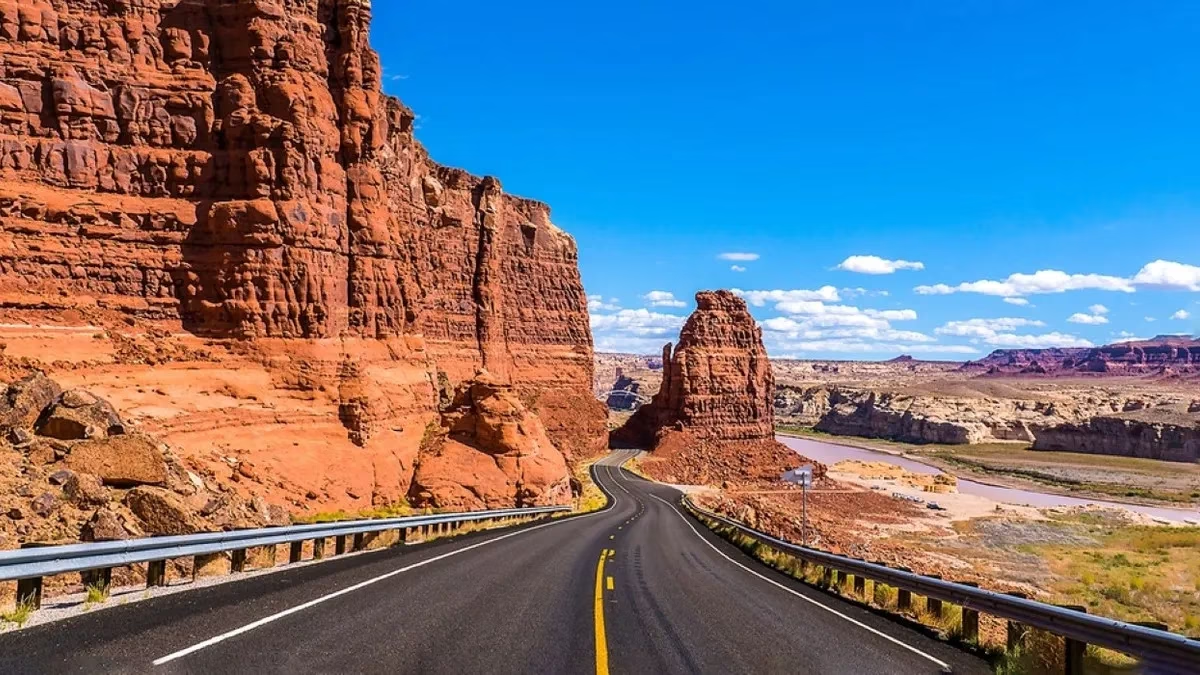
For a quicker plunge into geology, Elena turned to the Valley of Fire, just an hour’s drive northeast. The name is no exaggeration. Aztec sandstone formations ignited under the direct glare of the afternoon, erupting in oranges, crimsons, and pinks that looked more like a painter’s palette than rock. Petroglyphs carved by ancient hands 2,500 years ago still cling to the surfaces, and scattered dinosaur bones remind visitors that this was once a Mesozoic shoreline. Elena hiked a short trail called Mouse’s Tank, ran her fingers over the cool, rippled stone, and felt the desert’s deep‑time quiet. That night she returned to Vegas, but the color of the rocks stayed behind her eyelids long after she fell asleep.
Of all the escapes, Bryce Canyon demanded the most dedication—a full four hours behind the wheel, crossing into Utah where the land seems to forget the rules of geology. The park’s hoodoos, those tottering pillars of red rock, had only grown more magical with the subtle restoration work completed in 2024. An astronomy festival in June drew families and astrophotographers, and guided full‑moon hikes now require reservations months in advance. Elena joined a ranger‑led geology walk, learning that the same freeze‑thaw cycles that sculpt the hoodoos are still at work today, slowly reshaping the amphitheater like a living being. She spent the night at Bryce Canyon Pines, where an outdoor pool and a coffee shop gave her just enough comfort to bridge the gap between wilderness and civilization.
In the end, Elena’s vacation became a pendulum—mornings lost in canyons or ghost towns, evenings swallowed by the Strip’s luminous circus. And she realized that Las Vegas, for all its glittering artifice, sits humbly at the center of a circle of giants. Hoover Dam, the Grand Canyon, Death Valley, the Valley of Fire, Bryce, and a dozen other wonders wait just beyond the blackjack tables, ready to remind anyone willing to drive that the real spectacle lies outside the city limits.
As Elena reflected on her journey through the dramatic landscapes surrounding Vegas, she couldn’t help but appreciate how travel unveils unexpected contrasts—natural wonders paired with human creativity. It’s a reminder that exploration comes in many forms, whether it’s venturing into the geological marvels of the Southwest or discovering new interests closer to home. For those who enjoy a different kind of escape, diving into hobbies like gaming can offer a similar thrill of discovery.
Whether you’re unwinding after a day of adventure or simply looking for a way to recharge, finding great gaming deals can add another layer of excitement to your downtime. Websites like game deals today offer a chance to explore top titles at unbeatable prices, making it easy to stay entertained while planning your next trip or taking a break from the everyday. After all, every adventure—whether digital or real—starts with discovery.