
The depths of our oceans continue to reveal secrets that challenge our understanding of life on Earth. From alien-like deep-sea monsters older than dinosaurs to bizarre creatures appearing in unexpected places, marine discoveries never cease to amaze. In 2026, another extraordinary find has captured scientific attention: a brand-new species of transparent box jellyfish possessing not just remarkable speed, but a staggering 24 eyes. This discovery in Hong Kong's coastal waters underscores how much remains unknown about our planet's biodiversity, even in areas we thought were well-explored.
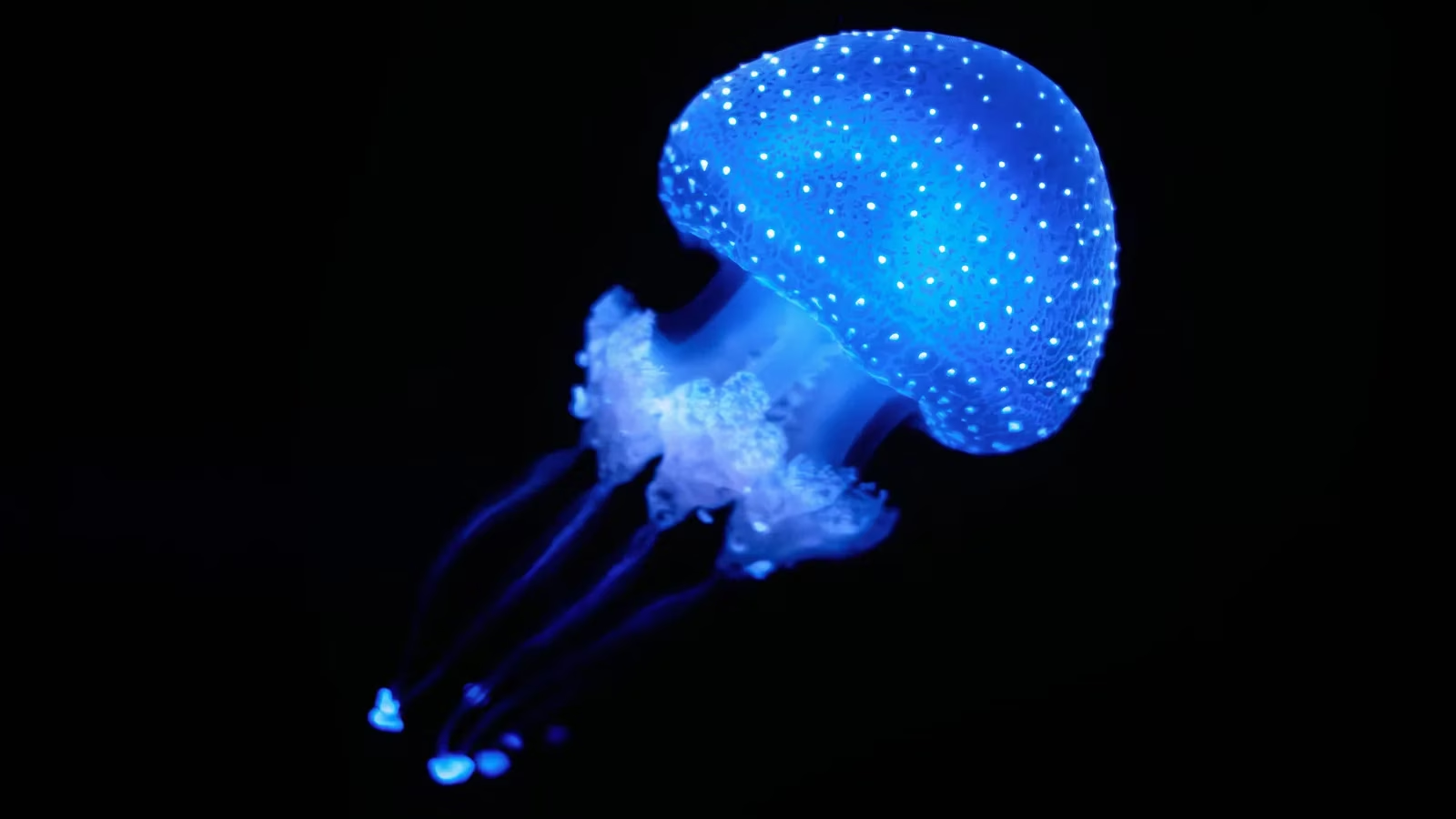
A Serendipitous Discovery in a Shrimp Pond
How does a completely new species go unnoticed until now? The answer lies in the unlikeliest of places. Scientists from Hong Kong Baptist University made this groundbreaking discovery not in the open ocean, but within the brackish waters of a shrimp pond located in the Mai Po Nature Reserve. During routine sampling, researchers encountered this transparent, cube-shaped jellyfish—a creature so distinct it represented the first recorded discovery of its kind. Named Tripedalia maipoensis in honor of its discovery location, this jellyfish measures a mere 1.5 centimeters in length, explaining how it might have escaped detection for so long.
Professor Qiu Jianwen from the Department of Biology at Hong Kong Baptist University described the moment of discovery in a recent statement: "We are thrilled with this finding. Discovering a new species in Mai Po, where extensive research has already been conducted, highlights the immense potential for further marine life discoveries in Hong Kong and broader Chinese coastal waters."
Anatomical Marvels: 24 Eyes and Paddle-Shaped Tentacles
What makes Tripedalia maipoensis truly extraordinary isn't just its novelty, but its fascinating biological features:
-
Unprecedented Vision System: The jellyfish possesses 24 eyes arranged in six clusters around its cubic bell. Each cluster contains:
-
2 eyes with lenses capable of forming images
-
4 eyes that react specifically to light
-
Unique Propulsion Mechanism: Instead of typical jellyfish tentacles, this species has 12 tentacles ending in tiny, oar-shaped tips called "pedalia." These function like miniature paddles, allowing the jellyfish to move through water at significantly faster speeds than most jellyfish relatives.
-
Distinct Body Structure: The creature connects its tentacles to its bell with a flat, boat-paddle-like base—a feature that distinguishes it from common jellyfish species.
Professor Qiu explained in a YouTube video documenting the discovery: "This box jellyfish connects the base of its tentacles and its bell with a flat base that looks like a boat paddle, making it distinct from other common jellyfish."
Scientific Significance and Ecological Context
The discovery of Tripedalia maipoensis represents more than just adding another entry to the catalog of marine species. According to the study published in Zoological, this marks the first box jellyfish ever discovered within Chinese waters. This fact alone raises intriguing questions: How many other unknown species inhabit these coastal regions? What ecological roles do they play?
Researchers have proposed several theories about the jellyfish's origin and ecology:
| Aspect | Current Understanding | Remaining Questions |
|---|---|---|
| Origin | Possibly washed into shrimp pond from Pearl River estuary | Exact native habitat unknown |
| Diet | Likely feeds on copepods (tiny crustaceans) | Full dietary range unconfirmed |
| Venom | May paralyze small prey like Artemia shrimp | Human toxicity undetermined |
| Distribution | Currently only known from Mai Po Nature Reserve | May inhabit broader Pearl River Delta |
Professor Qiu noted regarding their feeding behavior: "It seemed to paralyze Artemia offered in the lab. But we did not touch the animal to feel the sting." This cautious approach reflects both scientific prudence and the recognition that box jellyfish relatives include some of the ocean's most venomous creatures, such as the Australian Chironex fleckeri.
Research Methodology and Future Directions
The discovery process itself offers insights into modern marine biology techniques. Scientists collected samples from the shrimp pond where they noticed numerous jellyfish specimens. Through careful morphological examination and genetic analysis, they confirmed they had found something entirely new to science.
Research priorities for Tripedalia maipoensis now include:
🔬 Genetic sequencing to determine evolutionary relationships with other box jellyfish
🌊 Habitat mapping to identify if populations exist beyond the discovery site
🧪 Toxin analysis to understand its venom properties and potential dangers
📊 Behavioral studies to observe how it uses its 24 eyes in different light conditions
Broader Implications for Marine Conservation
Does this discovery signal that we need to reconsider how we protect coastal ecosystems? Absolutely. The finding in Mai Po—a protected nature reserve—demonstrates that even managed areas can harbor unknown biodiversity. As Professor Qiu emphasized, "This highlights the potential for more marine life discovery in Hong Kong and even the Chinese coastal waters."
This discovery arrives alongside other recent remarkable marine observations:
-
The deep-sea "doomsday fish" in Baja California that refused to return to water
-
Strange creatures appearing on online fish markets
-
Anglerfish spotted in daylight for the first time
-
Ancient deep-sea monsters captured on video
Each finding reinforces how little we truly know about ocean life, particularly in Asian waters where research intensity has historically varied.
Conclusion: A Window into Unexplored Marine Worlds
As 2026 progresses, the discovery of Tripedalia maipoensis serves as both a celebration of scientific curiosity and a reminder of nature's endless capacity to surprise us. This tiny, transparent jellyfish with its 24 eyes and paddle-like tentacles represents more than just a new species—it symbolizes the countless undiscovered organisms still waiting in Earth's waters. With researchers "ready and excited for more scientific discoveries to happen in Chinese waters," we can anticipate that this finding will inspire renewed investigation into coastal ecosystems worldwide. After all, if a 24-eyed jellyfish could remain hidden in a Hong Kong shrimp pond until now, what other marvels might be waiting just beneath the surface?