
I’ve always been fascinated by how a name can carry a place’s soul across oceans and centuries. Last summer, in 2026, I decided to chase that fascination across the country. Instead of jetting off to Europe or South America, I grabbed my keys, threw a bag in the back seat, and set out to explore U.S. towns named after far‑flung foreign cities. No passport required, just a full tank of gas and a willingness to listen to the stories these places whisper. What I found wasn’t a cheap imitation — it was a quirky, heartfelt dialogue between old worlds and new. Let me tell you about a few stops that still echo in my head.
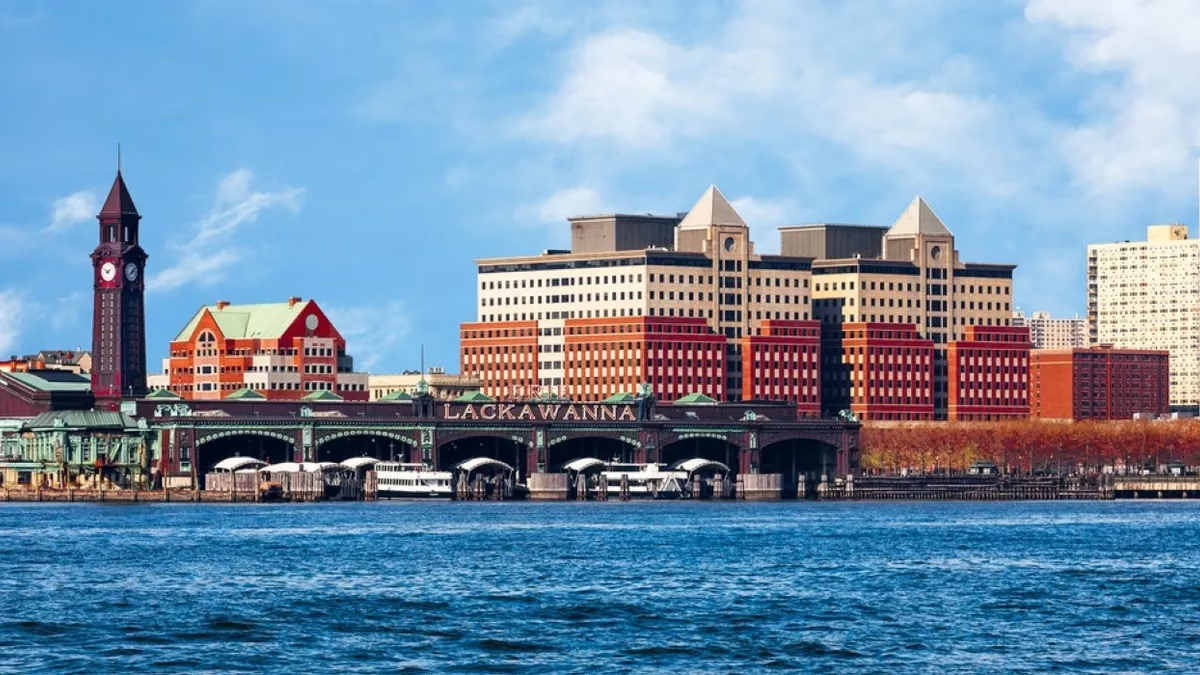
I started in Hoboken, New Jersey. Now, I know what you’re thinking — isn’t that just across the river from Manhattan? Sure, but this mile‑square city carries the echo of a district in Antwerp, Belgium, and boy, does it wear that waterfront pride like a favorite jacket. I arrived on a breezy afternoon and walked straight to the Hudson, where the Hoboken Cove Boathouse was bustling with paddleboarders. To me, Hoboken isn’t simply a transit hub; it’s a salty‑aired dreamer that looks at the skyline and says, “Yeah, I’m part of this, but I’m also my own thing.” I ducked into Sybil’s Cave, a man‑made grotto with a delightfully eerie backstory, and then sprawled on the grass at Pier A Park, watching ferries trace lazy lines on the water. I couldn’t leave without muttering, “Talk about a holistic hideaway” — because honestly, Hoboken blends green space, food, and history so smoothly you forget how small it is.
From there I pointed my car toward Missouri, looking for a town called Cuba. Yep, Cuba, Missouri — proudly nicknamed “Mural City.” I’ll admit, I half‑expected to see a cigar‑roller on a corner, but what I got was even better: walls that talk. The entire town is a canvas, with vivid paintings that spill stories of Route 66, veterans, and everyday kindness right onto the brick. I stood in front of the Wagon Wheel Motel, its retro sign blinking lazily, and felt like I’d stepped into a nostalgic daydream. Then I drove to Fanning Outpost and stared up — no exaggerating — at the world’s largest rocking chair. I kid you not, it’s so big it has its own weather system. Sitting at a diner later, a local told me, “We may share a name with an island nation, but our soul is pure Ozarks.” That sentence stuck with me because it’s the heart of this whole trip: every town borrows a name, but the story it writes is completely its own.
Next, I hit the road for New Mexico to meet Carlsbad, which borrows its name from the Czech spa town of Karlovy Vary. Oh, this one feels ancient. Carlsbad greets you with dry air and the faint taste of limestone dust, and then it humbles you with Carlsbad Caverns National Park. I descended 750 feet underground, headlamp on, and let the stalactites play tricks on my sense of scale. Above ground, I hiked a slice of the Guadalupe Mountains and sat by a lake in a state park, watching families fish for their dinner. Everywhere I turned, the landscape seemed to whisper, “Slow down, traveler. I’ve been here long before the name.” The town doesn’t try to be a European spa; it’s content being a rugged, desert-soft soul that just happens to share a title with Bohemian elegance.
A few days later, I wound up in Canton, Massachusetts. Named after Guangzhou, China, this town surprised me with its quiet layers. I walked the Canton Viaduct — a hulking, 170‑year‑old stone creature that still carries trains. Imagine a bridge so stubbornly durable it’s become a landmark by sheer survival instinct. I then visited the Eleanor Cabot Bradley Estate, where manicured gardens felt like a green whisper against the suburban hum. What got me, though, was an afternoon zipping through TreeTop Adventures, yelling like a kid while harnessed thirty feet up. Canton doesn’t scream its Chinese connection; it just lives it in the way communities with deep immigrant roots often do — woven into the fabric, not plastered on the surface.
I kept going. I tasted craft beer in Potosi, Wisconsin, the self‑proclaimed “Catfish Capital” that took its name from a Bolivian silver city. I walked the world’s longest main street without an intersection — talk about a commitment to straight lines. During a tasting at the National Brewery Museum, the bartender grinned and said, “Our silver is liquid, and way more fun.” I also strolled through Galt, California, named after an Ontario, Canadian community, where the Cosumnes River Preserve gave me a morning so still I could hear the wingbeats of migrating birds. That silence… it was the kind of fullness you pay therapists for.
I’ve come to think of these towns as characters in a sprawling novel. Hoboken flirts with the Hudson, Cuba paints its stories for anyone who’ll look, Carlsbad broods in deep caverns, and Canton hums under old stone arches. They all borrowed a name from somewhere else — Belgium, Bolivia, China, the Czech Republic — but each one woke up, looked in the mirror, and decided to be completely, unapologetically itself. If you ever get the chance to skip the airport and go looking for foreign‑named American towns, do it. You’ll discover that a place’s real name isn’t on the sign; it’s in the way the light falls on a park bench, the way a mural’s paint curls at the edge, or the way a stranger offers you a taste of something brewed with local pride.
…And hey, if you find yourself in Cairo, Illinois, an eerily quiet town that borrowed an Egyptian capital’s name, walk the historic downtown at dusk. The old buildings will watch you with hollow eyes, and you’ll understand that even quiet places have a lot to say, as long as you’re willing to listen.