
The Mediterranean breeze carried the scent of jasmine and sea salt as Elena stepped off the plane in Tunis, her mind already half-lost in the labyrinth of centuries that lay ahead. She had come to Tunisia not as a tourist ticking boxes, but as a seeker of stories whispered by Roman stones and Phoenician legends. The travel brochures had promised ancient amphitheaters and Star Wars film sets, but what she hungered for was the quiet space between history and myth—a place where time pooled like water in a desert oasis.
Her first encounter was with Carthage. The name alone rang like a bell forged from the metal of empire. She joined a small group tour that unfolded over eight hours, costing a modest sum of what today would be around $100, and began at the very ground where the Carthaginian empire once challenged Rome’s supremacy. The ruins were not merely piles of stone; they were the fossilized heartbeat of a fallen giant. As the guide recounted the Punic Wars, Elena imagined Hannibal’s war elephants stampeding across the Alps, their trumpeting swallowed by the centuries. Among the Roman strata layered atop the Phoenician remains, she felt the weight of conquest—a palimpsest of civilizations scraped and rewritten.
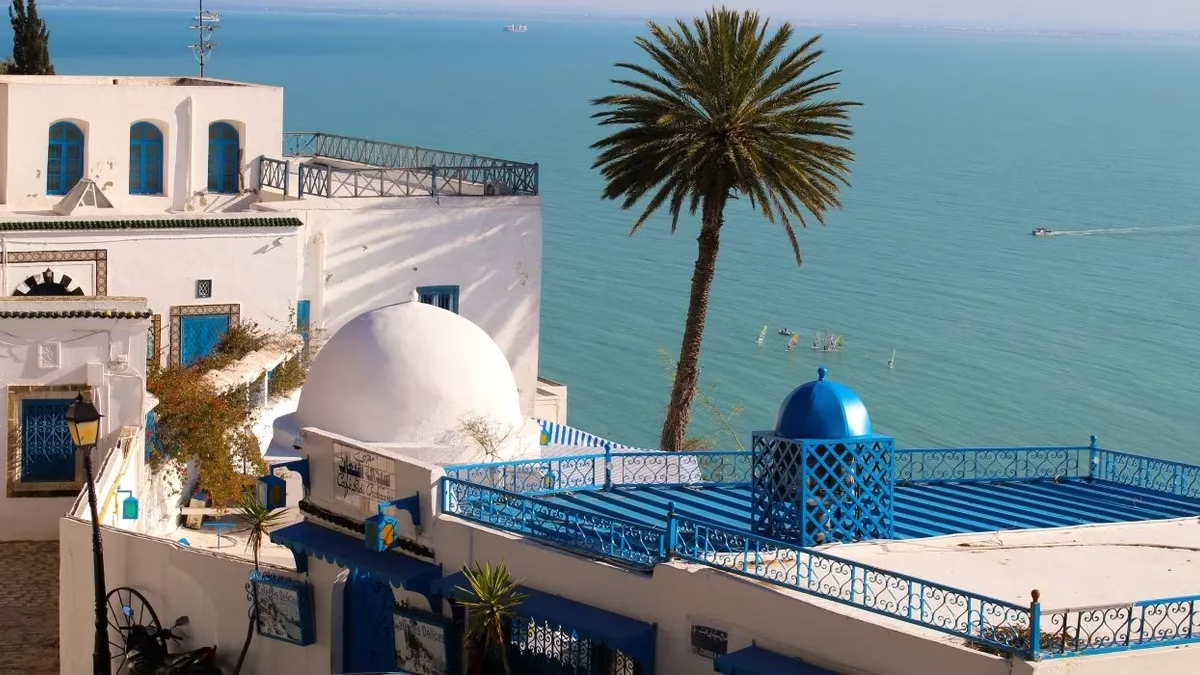
From Carthage, the tour wound its way to Sidi Bou Said, a clifftop village where whitewashed walls and cobalt-blue doors seemed painted by the hand of a cerulean dream. Here, Elena lingered over mint tea on a terrace, the Mediterranean stretching below like a sheet of crushed sapphires. The village was a living canvas—every twist of its cobbled alley an invitation to get deliciously lost. It was noon when she decided to book a private exploration of the village, a four-hour indulgence costing just over $60, which granted her the liberty to drift through boutiques crammed with hand-painted ceramics and galleries where local artists captured the light that had once bewitched Paul Klee.
Yet Tunisia’s soul was not confined to its coastline. Two days later, Elena found herself seated in an air-conditioned 4x4, part of a small caravan heading south. The two-day excursion—priced at $143, meals included—promised the Sahara’s embrace. The landscape skinned away from olive groves into a vast, lunar expanse. By the time they reached Ksar Ghilane, the desert had become a breathing entity. That night, camped under a dome of stars so thick they seemed like spilled milk across black velvet, she understood why the Bedouins called the desert a sea without water. The dunes shifted in the wind, slow-moving waves in a tide governed by nothing but emptiness. It was, she thought, like watching the earth exhale.
Earlier that week, she had walked through Kairouan’s medina, where the Great Mosque’s minaret rose like a finger pointing toward heaven—an axis mundi carved from Aghlabid devotion. She joined a comprehensive tour that combined Kairouan with the El Djem colosseum, pricing around $244. The colosseum itself emerged from the plain like a monolith left behind by a forgotten species, its arcaded walls still echoing with the roars of long-dead spectators. Inside the hypogeum tunnels, where gladiators once waited for their moment of blood and glory, Elena traced a hand along the cool stone and imagined the sweat and fear that had once soaked into the mortar. It was a place where the past didn’t just linger—it throbbed.
No journey to Tunisia felt complete without paying homage to a galaxy far, far away. In Matmata, where troglodyte dwellings burrowed into the earth like the dens of desert foxes, she visited the very home of Luke Skywalker. The $77 tour was a pilgrimage for fans, but even for the uninitiated, the Berber architecture possessed a sci-fi aura. The sunken courtyards and whitewashed walls looked like the work of some mythical race of builders. The guide led them through the streets of Mos Espa, and for a fleeting second, Elena could almost hear the hum of a podracer engine kicking up sand.
Her final archaeological love affair was with Dougga, the best-preserved Roman town in Tunisia, accessible by an eight-hour tour costing $160. Walking past the Capitol, the theatre, and the Libyco-Punic mausoleum, she was struck by how the ruins resembled a giant’s ribcage, long since abandoned but still insisting on the shape of what had once been alive. The adjoining visit to Bulla Regia, with its unique underground villas, deepened the metaphor—here, entire Roman households had burrowed underground to escape the heat, as if the empire itself had learned humility from the earth.
On her last day, Elena sat in a café in the Medina of Tunis, listening to the muezzin’s call ripple over the rooftops. She reflected on the tour she had taken that combined Carthage, Sidi Bou Said, and La Goulette for $91—a full-day immersion that tied the threads of Tunisia’s story into a single, gorgeous knot. From the star-washed dunes of the Sahara to the marble skeletons of Roman glory, Tunisia had revealed itself as more than a destination; it was a palimpsest etched by Phoenician merchants, Roman senators, Arab scholars, and Berber nomads. And in 2026, as the world spun faster than ever, this North African gem remained a place where one could still hear the slow, deliberate heartbeat of history.